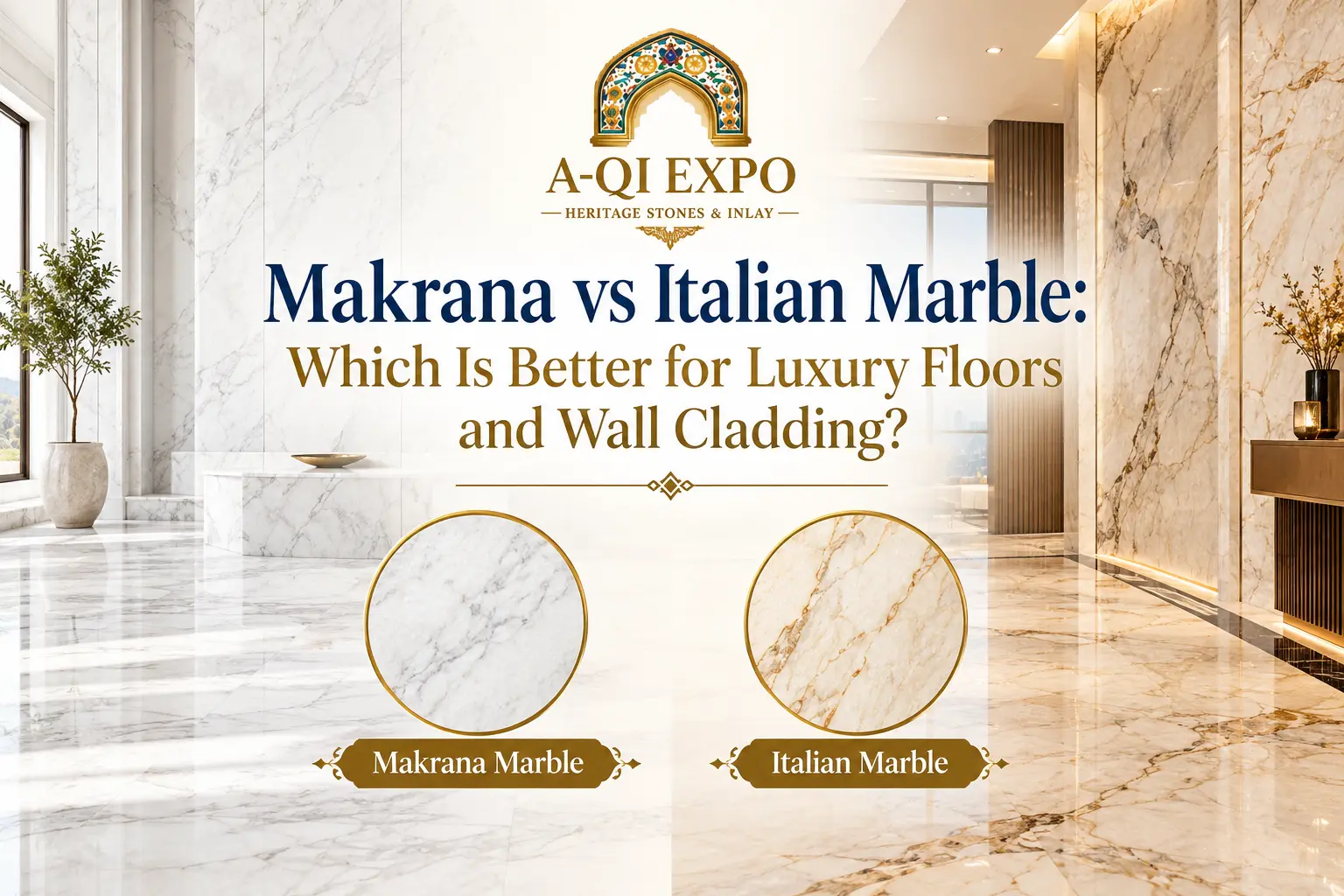
Choosing marble for a luxury interior involves more than selecting a beautiful colour. The stone must suit the design, intended use, maintenance expectations and overall project budget. Among the popular choices for premium properties, Makrana marble and Italian marble stand out for their distinctive appearance and natural beauty.
Makrana marble, sourced from Rajasthan, India, is known for its association with historic architecture, classic white surfaces and traditional craftsmanship. Italian marble, including varieties such as Carrara, Calacatta and Statuario, is valued for its refined appearance, distinctive veining and use in contemporary luxury interiors.
But which is better for luxury marble flooring and wall cladding? The answer depends on what matters most to your project. Makrana can be an excellent choice for timeless interiors and long-term use, while selected Italian varieties can create striking feature floors and statement walls. Understanding their differences will help you choose the right stone for your space.
What Is Makrana Marble?
Makrana marble is a natural stone quarried in and around Makrana in Rajasthan. It has a long history in Indian architecture and is famously associated with the Taj Mahal. Its heritage, natural white tones and ability to take a polished finish have made it a recognised choice for residential, religious and architectural projects.
Depending on the particular variety, Makrana marble can feature a bright white background, subtle natural markings or more noticeable patterns. This makes it suitable for interiors ranging from traditional homes to contemporary spaces that favour clean, understated surfaces.
Key Features of Makrana Marble
- Natural white appearance: Suitable for classic, minimal and traditional interiors.
- Long-standing reputation: Its use in historic architecture adds cultural significance to the material.
- Durability: Many Makrana varieties are valued for their strength and suitability for regular use when correctly installed.
- Polished finish: The stone can be finished to create a smooth, reflective surface.
- Domestic sourcing: As an Indian marble, it may be easier to source and replenish than a specific imported variety, depending on local availability.
Makrana marble is worth considering for living rooms, entrance areas, staircases, prayer rooms and selected wall applications. The exact grade, slab quality and finish should be assessed before choosing it for a particular project.
What Is Italian Marble?
Italian marble refers to natural marble varieties quarried in Italy. Different varieties have their own colours, vein patterns and surface characteristics, so the term does not describe one uniform material.
Carrara marble is known for its white to grey background and softer grey veining. Statuario often features a brighter white appearance with prominent grey patterns, while Calacatta varieties can display bold grey or golden veins against a light background.
These visual differences make Italian marble popular in projects where the stone itself is an important part of the interior design.
Key Features of Italian Marble
- Distinctive veining: Natural patterns can create a strong visual feature.
- Variety of appearances: Different types offer white, grey, beige and other colour combinations.
- Premium interior appeal: Selected varieties suit luxury residences, hotels and commercial interiors.
- Large-format design possibilities: Suitable slabs can be arranged to create continuous-looking patterns and book-matched wall panels.
- Multiple finishes: Depending on the stone and application, polished, honed and other finishes may be available.
Italian marble can work particularly well in feature walls, formal living rooms, hotel lobbies and other areas where colour, pattern and visual impact are priorities.
Makrana vs Italian Marble: Quick Comparison
| Feature | Makrana Marble | Italian Marble |
| Origin | Rajasthan, India | Italy, depending on the variety |
| Appearance | Often classic white with natural variations | White, grey, beige and distinctive veining |
| Design style | Timeless, traditional and contemporary | Modern, classic and statement interiors |
| Durability | Many varieties are valued for strength | Performance varies by variety |
| Flooring | Suitable for residential and selected commercial floors | Suitable for luxury floors when the variety matches the application |
| Wall cladding | Works for clean, elegant and decorative walls | Popular for feature walls and book-matched designs |
| Maintenance | Requires appropriate marble care | Requires appropriate marble care |
| Cost factors | Grade, colour, thickness and finish | Variety, origin, slab quality, import and availability |
| Best design advantage | Classic appearance and heritage | Distinctive patterns and design variety |
This comparison is a general starting point. Actual performance and appearance depend on the specific stone, its quality, the installation method and the conditions in which it will be used.
Read Also : Rajasthan’s Master Stone Artisans: The Art Behind Luxury Marble Inlay
Which Marble Is Better for Luxury Flooring?
Both Makrana and Italian marble can be used for luxury flooring. The better option depends on the appearance you want, how frequently the floor will be used and how much maintenance you are prepared to undertake.
Makrana Marble for Flooring
Makrana marble is a strong option for homeowners who prefer a classic white floor with a relatively understated appearance. Its natural character can complement traditional furniture, wooden accents, decorative borders and contemporary interiors.
It can be considered for living rooms, bedrooms, entrance halls and other indoor spaces. Its reputation for durability also makes it worth evaluating for areas that experience regular foot traffic.
However, the quality of individual slabs matters. Check for cracks, filled areas, uneven colour and other natural characteristics before purchasing. Professional installation and suitable finishing are essential to achieving a consistent result.
Italian Marble for Flooring
Italian marble is often selected when the floor is intended to become a central design feature. Depending on the variety, its natural veins can introduce movement, contrast and visual depth into a room.
Carrara can suit interiors that call for subtle patterns, while Statuario and Calacatta varieties may be better suited to projects seeking more prominent veining. Large slabs can also create a more continuous appearance when the pattern and dimensions are planned carefully.
Italian marble is not automatically more durable or better suited to every floor. Some varieties are more sensitive to scratches, staining or surface etching than others. The specific material should be assessed for the expected foot traffic, cleaning routine and installation conditions.
Flooring recommendation: Consider Makrana for a timeless white aesthetic and a practical long-term flooring choice. Choose Italian marble when a particular colour, vein pattern or slab arrangement is central to the design.
Makrana vs Italian Marble for Wall Cladding
Wall cladding offers different opportunities from flooring because the surface generally experiences less direct wear from foot traffic. This allows greater emphasis on patterns, proportions and decorative impact.
Makrana Marble Wall Cladding
Makrana marble can create a clean and elegant backdrop for living rooms, entrance walls, staircases and selected feature areas. Its white appearance can complement wood, metal, glass and other interior materials.
It is suitable for designs where the aim is to create a bright stone surface without making the wall visually busy. Depending on the selected variety, decorative borders or contrasting stone details can also be incorporated.
The wall structure, slab weight, fixing method and moisture conditions must be assessed by the project team before installation.
Italian Marble Wall Cladding
Italian marble can be particularly effective for statement walls. Strong natural veins can become part of the artwork, especially when slabs are positioned to follow a deliberate pattern.
Book-matching is one popular approach. Two adjacent slabs are arranged so that their vein patterns mirror one another, producing a symmetrical design. This works well with selected Statuario and Calacatta slabs, although the result depends on the actual stone.
Italian marble can be considered for reception areas, luxury living rooms, hotel interiors and feature walls behind selected furniture or architectural elements.
Wall cladding recommendation: Makrana suits elegant, understated surfaces, while Italian marble may be preferable when the design requires bold natural patterns or a book-matched feature wall.
Makrana vs Italian Marble: Which Is More Durable?
Durability should be evaluated at the level of the actual stone rather than by origin alone. Makrana marble has a strong reputation for hardness and long-term use, but the quality of the slab, its natural features, thickness and installation still matter.
Italian marble includes many different varieties with varying physical properties. Some may require more careful handling and maintenance, particularly in areas exposed to abrasive dirt, frequent use or spills.
Both materials are natural marble and can be affected by acidic substances. Lemon juice, vinegar and certain household cleaners can damage the polished surface through etching. Scratches and staining can also occur if the stone is not maintained properly.
For a flooring project, ask the supplier about the particular variety’s suitability for the intended use. For wall cladding, check the slab’s condition and confirm that the fixing system is appropriate for its weight and dimensions.
Makrana Marble vs Italian Marble: Cost Factors
The price difference between Makrana and Italian marble depends on the selected varieties and the supplier. Italian marble may carry additional costs associated with importing, transportation, handling and sourcing specific slabs. Premium Makrana varieties can also command higher prices based on their appearance and quality.
Instead of comparing only the price per square foot, consider the total installed cost.
| Cost factor | What to check |
| Material price | Variety, grade, slab dimensions and quality |
| Transportation | Distance, handling and delivery arrangements |
| Wastage | Cutting requirements and pattern matching |
| Installation | Skilled labour, adhesives and fixing systems |
| Finishing | Grinding, polishing and edge treatment |
| Maintenance | Suitable cleaning products, sealing and future restoration |
Prices vary by location, supplier, slab quality and project specifications. Obtain current quotations for the exact materials being considered, and confirm whether the quote includes installation, polishing, taxes and delivery.
For a fair comparison, request quotations for comparable slab thicknesses, finishes and quantities. A low material price may not represent the lowest overall project cost if the stone requires additional handling or more complex installation.
Maintenance: Which Marble Is Easier to Maintain?
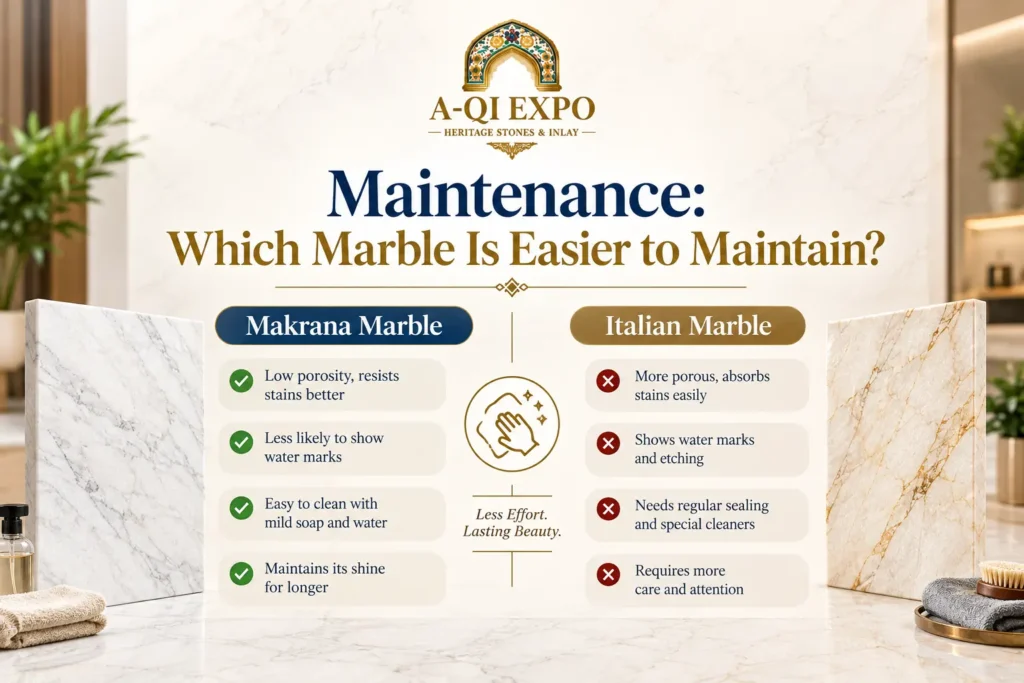
Neither Makrana nor Italian marble should be treated as maintenance-free. Both benefit from regular cleaning and suitable surface care.
Use a soft mop or cloth and a pH-neutral cleaner intended for natural stone. Avoid acidic cleaners, abrasive pads and unapproved chemicals. Clean spills promptly, especially those involving citrus, vinegar, coloured liquids or other substances that may stain or etch the surface.
Sealing requirements depend on the particular stone, finish and application. A suitable impregnating sealer can help reduce liquid absorption, but it does not make marble completely stain-proof or prevent acid etching.
For floors, use entrance mats where appropriate to limit abrasive dirt and grit. For wall cladding, follow the supplier’s instructions for cleaning and moisture management. Professional polishing or restoration may be needed over time, depending on wear and the desired appearance.
The best way to manage maintenance is to obtain care instructions for the exact stone before installation rather than assuming all varieties require the same treatment.
How to Choose the Right Marble for Your Interior
Before making a final decision, consider these practical points:
1. Decide on the design. Choose whether you prefer a classic white surface, subtle natural markings or prominent veins that make the stone a focal point.
2. Match the stone to the application. Flooring and wall cladding have different performance and installation requirements. Confirm that the selected variety is suitable for the intended use.
3. Inspect full slabs. Small samples may not show the full pattern or natural variation. Review the actual slabs under good lighting, especially for large floors and feature walls.
4. Check installation requirements. Discuss slab dimensions, substrate preparation, joints, fixing systems and polishing with an experienced installer.
5. Set a complete project budget. Include material, delivery, wastage, labour, finishing and future maintenance rather than comparing stone prices alone.
6. Ask about sourcing and documentation. Confirm the stone’s identity, variety and origin with the supplier. This is particularly important when purchasing premium imported marble.
Makrana or Italian Marble: The Final Verdict
There is no single winner in the Makrana vs Italian marble comparison. Each material serves a different design purpose, and the right choice depends on the requirements of the project.
Makrana marble is worth considering for homeowners who prefer a classic white appearance, value Indian stone craftsmanship and want a material suited to a range of traditional and contemporary interiors.
Italian marble may be the better fit when the design calls for a particular vein pattern, a distinctive colour or a statement surface that draws attention. Selected varieties can create impressive flooring and wall cladding, provided their characteristics match the application and maintenance expectations.
For luxury interiors, the most effective approach is to compare actual slabs, review installation requirements and assess the full project cost. Good material selection and professional workmanship are just as important as the marble’s origin.
At AQJ EXPO, natural stone surfaces and bespoke inlay options can support architectural projects that require thoughtful material selection and distinctive detailing. Visit AQJ EXPO to view its collections and discuss stone requirements for your next project.
Frequently Asked Questions
Is Makrana marble better than Italian marble?
Makrana marble can be a good choice for classic white interiors and projects that prioritise durability and domestic sourcing. Italian marble may be preferable when a specific colour or dramatic natural veining is important. The better option depends on the variety and intended application.
Which marble is best for luxury flooring?
Both can work well. Makrana is worth considering for timeless white floors, while selected Italian varieties suit statement flooring and distinctive vein patterns. Slab quality, installation and maintenance should influence the final choice.
Is Italian marble suitable for wall cladding?
Yes. Selected Italian marble varieties are used for feature walls, reception areas and decorative interior panels. The stone’s weight, slab dimensions and fixing system should be evaluated before installation.
Is Makrana marble expensive?
Makrana marble is available in different grades and varieties. Its price depends on colour, quality, dimensions, finish and supplier. Premium slabs may cost more than standard varieties.
Does Italian marble require more maintenance?
Maintenance requirements vary by variety and application. Some Italian marbles need careful attention to staining, scratches and etching. Like other natural marble, Makrana also requires appropriate cleaning and care.
Can Makrana and Italian marble be used together?
Yes. They can be combined in suitable projects to create contrast between a classic white background and more expressive patterns. The materials should be coordinated for colour, thickness, finish and installation requirements.